
Paid Search Agency
Paid Search Agency In Houston
Reach customers while they are actively searching for the products, services, and solutions your business provides. GudBee plans, builds, manages, and improves paid search campaigns across Google Ads and Microsoft Advertising.
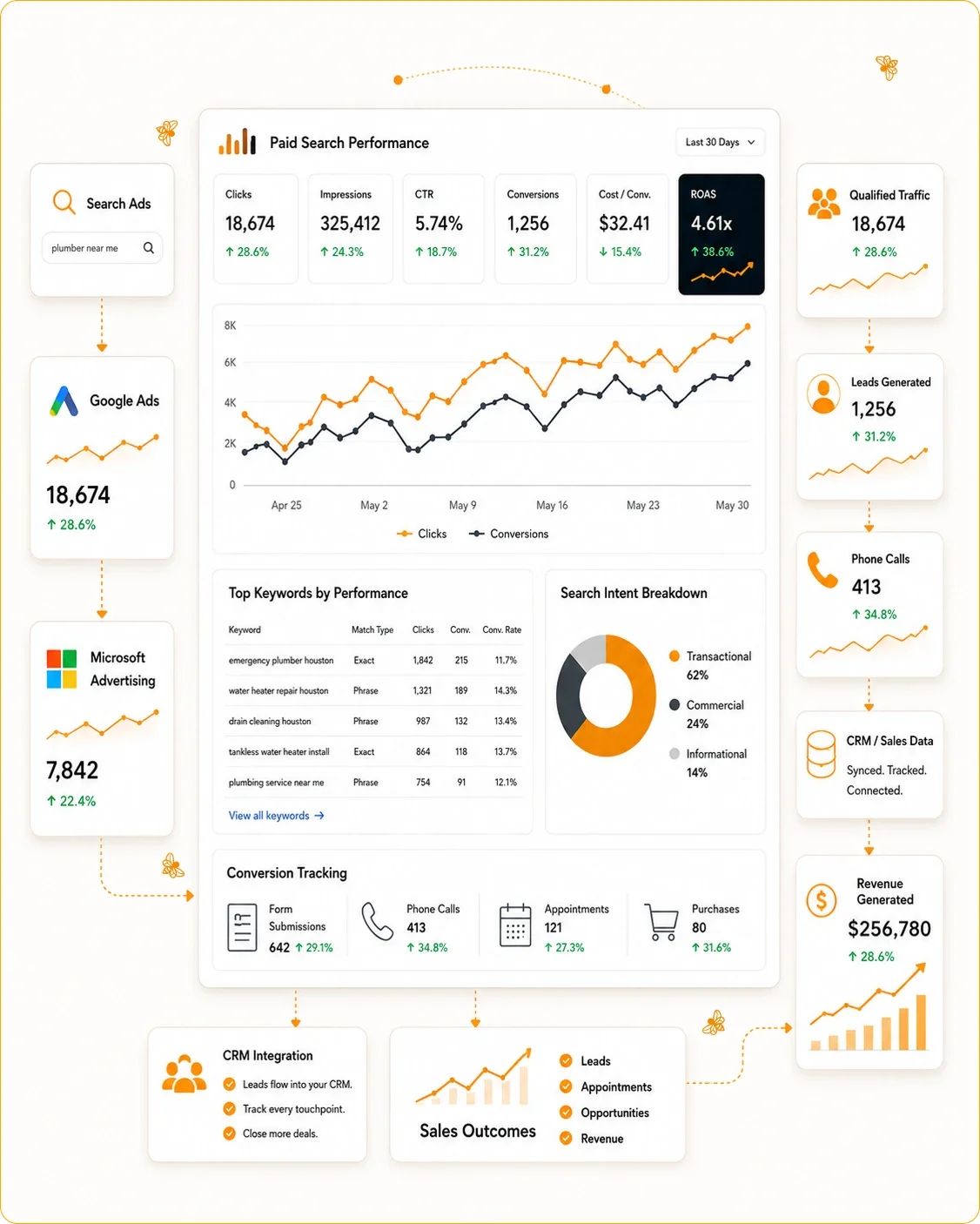
We connect customer intent, keywords, advertisements, landing pages, conversion tracking, CRM data, lead quality, and sales outcomes into one measurable acquisition system. The goal is not to buy more clicks. It is to capture the right searches, guide qualified customers toward action, and invest your budget in campaigns that produce leads, purchases, appointments, opportunities, and revenue.
Improve Your Paid Search CampaignsA Connected Paid Search Acquisition System
Paid Search Should Capture Demand Without Wasting Budget
Paid search places your business in front of people who are already looking for an answer, provider, product, service, or next step. However, high customer intent does not automatically produce strong campaign performance.
GudBee evaluates the complete paid search journey—from the search query and advertisement through the landing page, phone call, form, lead response, sale, and revenue outcome—to identify where valuable demand is being captured and where budget is being lost.
Turn High-Intent Searches Into Qualified Customers
GudBee reviews search demand, customer intent, account structure, keywords, search terms, advertisements, bidding strategies, geographic settings, landing pages, phone calls, forms, conversion tracking, CRM stages, lead quality, and available revenue data.
We correct the areas creating waste and build a paid search system around meaningful outcomes such as qualified leads, appointments, purchases, enrollments, sales opportunities, revenue, and sustainable customer acquisition costs.
Paid Search Performance Gaps
Where Paid Search Budget Is Commonly Lost
- Advertisements appear for irrelevant, low-value, informational, or unrelated searches that are unlikely to create customers.
- Broad keyword targeting consumes budget without enough negative keywords, search-term review, exclusions, or intent controls.
- Campaigns treat every keyword and search as equally valuable instead of separating research, comparison, purchase, and urgent customer intent.
- Advertisements promise one message, offer, product, or service while the landing page delivers a different or generic experience.
- Bidding systems optimize toward every form submission or phone call even when many of those conversions are unqualified or cannot become customers.
- Conversion tracking is missing, duplicated, incorrectly valued, or focused on supporting actions instead of primary business outcomes.
- Phone calls go unanswered, forms are routed incorrectly, or prospects wait too long for follow-up after completing a paid search conversion.
- Geographic, device, schedule, audience, network, or campaign settings direct budget toward markets and conditions that do not support the business.
- Qualified leads, purchases, opportunities, sales, and revenue are never connected to the keywords, searches, advertisements, or campaigns that originally created them.
GudBee connects search intent, account structure, keywords, advertisements, landing pages, conversion tracking, lead handling, CRM data, and revenue outcomes so paid search can be optimized using the customer signals that matter—not clicks and form volume alone.
Paid Search Experience
Trusted by Brands That Need Search Advertising to Perform
GudBee works with service companies, e-commerce businesses, multi-location organizations, financial services providers, travel brands, energy companies, professional firms, and internal marketing teams that need paid search to generate measurable customer and revenue outcomes.
Some businesses need ongoing Google Ads and Microsoft Advertising management. Others need focused support restructuring an underperforming account, reducing acquisition costs, fixing conversion tracking, entering a new market, improving landing pages, or increasing the quality of leads delivered to sales.
Flexible Paid Search Support
Search Advertising Support Built Around the Performance Problem
Ongoing Account Management
GudBee manages campaign strategy, keywords, search terms, advertisements, audiences, bids, budgets, geographic settings, landing pages, conversion tracking, testing, reporting, and recurring optimization.
Account Restructuring and Repair
We identify overlapping campaigns, weak keyword organization, irrelevant search traffic, incorrect conversion goals, budget conflicts, bidding problems, and other structural issues that limit performance.
Acquisition Cost Improvement
GudBee evaluates which searches, audiences, devices, markets, schedules, advertisements, landing pages, and offers create qualified customers—and where media spend is producing little business value.
Conversion Tracking and CRM Integration
We connect advertisements with calls, forms, purchases, appointments, qualified leads, CRM stages, opportunities, sales, and available revenue data so optimization is not based on clicks or low-value conversions alone.
New Market and Campaign Launches
GudBee researches search demand, customer intent, competition, geographic conditions, expected costs, conversion requirements, landing-page needs, and testing priorities before launching into a new market.
Lead Quality and Sales Alignment
We connect keyword intent, advertisements, forms, phone calls, qualification criteria, lead routing, response time, sales acceptance, and closed outcomes to identify which campaigns create customers sales can pursue.
Every Paid Search Campaign Needs Five Clear Standards
- A defined customer audience
- A clear campaign purpose
- An accountable media budget
- A valuable conversion goal
- A documented optimization plan
GudBee gives every campaign a defined audience, business purpose, budget, conversion goal, measurement framework, and optimization plan so search advertising can be evaluated by the qualified customers, sales, and revenue it helps create.


Google Ads and Microsoft Advertising Services
Paid Search Services in Houston
GudBee helps businesses capture high-intent search demand, reduce irrelevant traffic, improve account control, strengthen landing-page conversion, and connect Google Ads and Microsoft Advertising investment to qualified leads, purchases, appointments, pipeline, revenue, and customer value.
Paid Search Account Audits
A campaign can generate leads while still wasting a significant portion of its budget on poor-fit searches, overlapping structures, weak conversion signals, or unqualified customers.
GudBee audits:
- Irrelevant search terms
- Weak or duplicated keywords
- Competing campaigns
- Poor geographic targeting
- Missing negative keywords
- Budget-allocation problems
- Ineffective bidding strategies
- Weak ad-to-page alignment
- Duplicate or missing conversions
- Low-quality lead sources
- Unused account capabilities
- Incomplete downstream reporting
You receive a prioritized correction plan explaining what should be fixed, paused, tested, consolidated, restructured, or expanded.
Request a Paid Search Audit
Paid Search Strategy
A paid search strategy should define more than a list of keywords. GudBee builds the plan around business goals, customer needs, sales processes, geography, competition, margins, budget, conversion rates, and available data.
The strategy defines:
- Customer-intent categories
- Campaign objectives
- Platform roles
- Brand and non-brand coverage
- Geographic priorities
- Keyword themes
- Exclusion requirements
- Landing-page needs
- Conversion definitions
- Bidding approach
- Budget allocation
- Testing priorities
- Performance thresholds
This gives each campaign and each dollar invested a defined business purpose.
Build Your Paid Search Strategy
Google Ads Search Campaign Management
GudBee builds and manages Google Search campaigns around the searches most likely to create qualified customer actions.
Our work may include:
- Campaign and ad-group architecture
- Keyword research
- Match-type selection
- Negative keywords
- Search-term reviews
- Geographic targeting
- Audience observation
- Bid management
- Budget controls
- Responsive search ads
- Advertising assets
- Landing-page alignment
- Conversion tracking
- Lead-quality analysis
Automation is balanced with human oversight so campaign growth does not come at the expense of relevance, customer quality, or sustainable acquisition economics.
Improve Your Google Ads Campaigns
Microsoft Advertising Management
Microsoft Advertising can provide incremental search reach, but campaigns should not be copied from Google Ads without reviewing the audience, network, budget, search behavior, and platform differences.
GudBee can build new campaigns or selectively import and adapt existing structures. We review search terms, partner traffic, advertisements, audiences, budgets, devices, conversion quality, and platform-specific opportunities.
Improve Your Microsoft Ads Campaigns
Keyword and Search-Intent Research
Two customers can use similar keywords while needing completely different information or being at different stages of the buying journey.
GudBee groups searches by:
- Customer problem
- Product or service
- Research intent
- Comparison intent
- Transactional intent
- Brand intent
- Location
- Urgency
- Customer journey stage
- Expected business value
This helps separate high-value customer searches from broad research activity that is less likely to convert.
Find Your Highest-Value Searches
Search-Term Management
Keywords represent the searches a campaign intends to target. Search terms reveal what people actually typed before seeing or clicking an advertisement.
GudBee reviews search terms to identify:
- Irrelevant searches
- New keyword opportunities
- Customer language
- Unexpected use cases
- Competitor searches
- Research-only traffic
- Poor-fit locations
- Job seekers
- Customer-support requests
- Low-value inquiries
Findings are used to improve keyword targeting, negatives, advertising copy, landing pages, content, and broader customer messaging.
Improve Search-Term Quality
Negative Keyword Management
A paid search campaign should be clear about the customers and searches it does not need to reach.
GudBee develops negative keyword lists at the account, campaign, or ad-group level to exclude irrelevant products, services, locations, employment searches, educational intent, support requests, free resources, and other searches unlikely to create meaningful value.
Negative keywords are reviewed continuously because search behavior, terminology, match behavior, and campaign coverage change over time.
Reduce Irrelevant Search Spend
Campaign and Account Architecture
Poor account structure can make budgets difficult to control, search intent difficult to separate, and performance difficult to interpret.
GudBee may organize campaigns by:
- Product or service
- Customer intent
- Geography
- Brand versus non-brand
- Audience
- Profitability
- Conversion type
- Sales process
- Landing-page destination
- Budget priority
The structure provides enough control for meaningful decisions without creating more campaigns than the available data can support.
Restructure Your Search Account
Brand Search Campaigns
Customers searching for your brand may also encounter competitors, directories, review platforms, marketplaces, resellers, or inaccurate information.
GudBee evaluates:
- Competitor activity
- Organic visibility
- Brand-query variations
- Location searches
- Product and service searches
- Promotional messaging
- Customer-support traffic
- Existing-customer behavior
- Incremental conversion value
Brand campaigns are measured separately from non-brand acquisition so inexpensive branded conversions do not hide weak prospecting performance.
Protect Branded Search Demand
Non-Brand Search Campaigns
Non-brand campaigns introduce your business to customers searching for a need, problem, product, service, or solution without naming your company.
GudBee builds non-brand campaigns around customer intent, competitive conditions, relevant geography, landing-page alignment, and realistic acquisition economics.
The objective is to reach qualified new customers without paying for every broad search related to the industry.
Capture New Customer Demand
Competitor Search Campaigns
Customers sometimes search for a known competitor while remaining open to another provider, product, or solution.
GudBee evaluates:
- Search volume
- Click costs
- Brand awareness
- Trademark limitations
- Landing-page relevance
- Comparison criteria
- Conversion quality
- Customer acquisition cost
When appropriate, advertisements focus on your own value proposition rather than making unsupported claims about another organization.
Evaluate Competitor Search Opportunities
Responsive Search Advertisement Development
Responsive search advertisements should test distinct customer needs and value messages rather than several versions of the same general statement.
Messaging may test:
- Problems solved
- Product or service benefits
- Pricing and promotions
- Convenience
- Availability
- Speed
- Locations
- Proof and credibility
- Policies or guarantees
- Differentiators
- Calls to action
GudBee reviews platform asset information together with actual conversion and customer-quality outcomes before deciding what to change.
Improve Your Search Advertisements
Advertising Asset Optimization
Search advertisements can include supporting links, calls, images, locations, prices, promotions, and structured business information.
GudBee selects assets based on what helps customers understand the offer and complete the next step. We verify destinations, phone numbers, schedules, location information, promotions, and tracking before launch.
Assets are managed as part of the complete campaign rather than added only to make an advertisement appear larger.
Strengthen Your Search Ads
Offer and Message Testing
A campaign may reach the right customer while presenting an offer or message that does not provide enough reason to act.
GudBee may test:
- Free consultations
- Estimates
- Pricing
- Trials
- Financing
- Promotions
- Bundles
- Availability
- Guarantees
- Shipping
- Urgency
- Convenience
- Product benefits
- Proof and expertise
GudBee documents what changed and whether the result is strong enough to guide future advertising, website, and sales messaging.
Test Your Search Offer
Paid Search Budget Planning
Paid search budgets should reflect available demand, click costs, conversion rates, customer value, margins, sales capacity, and the amount of data needed to make responsible decisions.
GudBee develops scenarios showing:
- Estimated traffic
- Expected conversion volume
- Target acquisition cost
- Priority campaigns
- Testing requirements
- Market differences
- Break-even economics
- Conditions for scaling
- Conditions for reducing spend
Forecasts use documented assumptions and are planning tools rather than guaranteed outcomes.
Plan Your Search Budget
Bid Strategy Management
The appropriate bidding strategy depends on the campaign objective, conversion quality, available data, customer value, account maturity, and level of budget control required.
GudBee evaluates manual and automated approaches and determines whether a campaign should optimize toward clicks, conversions, conversion value, acquisition cost, or advertising return.
Automated bidding can only optimize around the conversion signals it receives, so GudBee also evaluates whether those signals represent valuable customer outcomes.
Improve Your Bidding Strategy
Match-Type and Query Expansion Management
Exact, phrase, and broad match can each play a role depending on search volume, conversion data, campaign maturity, budget tolerance, and the level of control required.
Before expanding match coverage, GudBee reviews:
- Conversion accuracy
- Search-term quality
- Negative keyword coverage
- Budget tolerance
- Bid strategy
- Customer value
- Campaign history
- Landing-page relevance
Match expansion is treated as a controlled test rather than an automatic response to platform recommendations.
Improve Keyword Matching
Local Paid Search
Local paid search campaigns should help nearby customers complete a specific action with the correct business or location.
Campaigns may focus on:
- Phone calls
- Appointments
- Quote requests
- Directions
- Location visits
- Local inventory
- Service availability
- Urgent customer needs
- City and neighborhood demand
GudBee aligns geography, advertisements, business information, schedules, landing pages, phone numbers, and lead routing so customers reach the correct market.
Capture Local Search Demand
Multi-Location Paid Search
Multi-location organizations can waste budget when locations target the same customers, use inconsistent offers, or route leads and calls incorrectly.
GudBee creates systems for:
- Market-level budgets
- Geographic boundaries
- Location-specific advertisements
- Local landing pages
- Phone and form routing
- Service availability
- Promotional differences
- Brand controls
- Location exclusions
- Market-level reporting
- Shared negative keywords
- New-location launches
Leadership receives central oversight while campaigns retain legitimate local-market relevance.
Improve Multi-Location Search Campaigns
Lead-Generation Search Campaigns
A low cost per lead provides little value when prospects cannot be contacted, do not qualify, or never become customers.
GudBee connects campaigns with:
- Form completion
- Phone calls
- Appointment scheduling
- Qualification status
- Sales acceptance
- Opportunity creation
- Proposal activity
- Closed sales
- Revenue
- Customer value
Campaigns can then be optimized around the quality of customers generated rather than form volume alone.
Generate Better Search Leads
Call-Focused Search Campaigns
For some businesses, the phone call is the most valuable paid search conversion.
GudBee evaluates call assets, click-to-call activity, call tracking, business hours, call duration, missed-call rates, routing, conversation outcomes, qualification, and sales follow-up.
The goal is to determine whether advertising produces meaningful customer conversations rather than call volume the business cannot answer or serve.
Improve Paid Search Calls
B2B Paid Search
B2B paid search campaigns often involve expensive keywords, smaller audiences, long sales cycles, and multiple decision-makers.
GudBee organizes campaigns around business problems, industries, services, use cases, company needs, and buying stages.
Search activity can be connected with:
- Marketing-qualified leads
- Sales-qualified leads
- Meetings
- Opportunities
- Pipeline
- Proposals
- Closed revenue
This prevents B2B campaigns from being judged only by downloads or form submissions.
Build a B2B Search Program
E-commerce Paid Search
Paid search can reach customers looking for a specific product, category, brand, use case, or solution even when the campaign does not use a product-feed format.
GudBee can manage:
- Product and category keywords
- Brand and non-brand searches
- Promotional searches
- Availability messages
- Pricing messages
- Search advertisements
- Category landing pages
- Product landing pages
- Purchase tracking
- Revenue
- Margin and profitability
- New versus returning customers
Product-feed campaigns can be coordinated separately with GudBee’s e-commerce and shopping advertising services.
Improve E-commerce Search Campaigns
Regulated and High-Consideration Search Campaigns
Financial, legal, healthcare, energy, and other high-consideration industries often face expensive clicks, advertising restrictions, longer decision processes, and customers who need more information before acting.
GudBee develops campaigns around accurate messaging, approved claims, relevant disclosures, geographic restrictions, platform policies, qualification requirements, and useful landing-page information.
Legal and regulatory approval remains the responsibility of the client and its qualified legal or compliance advisors.
Build a More Responsible Search Campaign
Paid Search Landing Pages
A paid search advertisement and landing page should feel like one continuous customer experience.
GudBee evaluates:
- Message consistency
- Page speed
- Mobile usability
- Headline clarity
- Product or service information
- Forms
- Phone numbers
- Proof and trust
- Pricing
- Objection handling
- Calls to action
- Confirmation pages
- Lead routing
Qualified search traffic should reach a focused destination that directly answers the customer’s query and supports the intended action.
Improve Your Search Landing Pages
Conversion Rate Optimization
Increasing paid search traffic is not always the fastest or most efficient way to generate more customers.
GudBee analyzes what happens after the click to identify problems involving forms, mobile experiences, navigation, calls to action, trust, information gaps, checkout steps, scheduling, phone calls, and page performance.
Recommendations are prioritized according to expected business impact, implementation effort, traffic volume, and customer value.
Convert More Search Traffic
Paid Search Conversion Tracking
Paid search campaigns cannot be optimized responsibly when conversions are missing, duplicated, incorrectly valued, or disconnected from actual business outcomes.
GudBee configures and validates tracking for:
- Forms
- Phone calls
- Appointments
- Purchases
- Registrations
- Downloads
- Applications
- Qualified leads
- Opportunities
- Revenue
Primary business conversions are separated from supporting actions so bidding systems are not trained to prioritize low-value activity.
Fix Your Search Conversion Tracking
Enhanced and First-Party Conversion Measurement
Browser limitations, consent decisions, and disconnected systems can reduce the amount of conversion information available to advertising platforms.
When appropriate, GudBee can help implement supported enhanced conversion measurement using approved first-party information and compatible technical methods.
Implementation depends on technical capabilities, data quality, approved privacy practices, consent requirements, and advertising platform specifications.
Improve Conversion Measurement
CRM and Offline Conversion Integration
The most valuable paid search outcome may occur after a customer submits a form, calls the business, schedules an appointment, or begins an application.
GudBee helps preserve campaign data through stages such as:
- Contacted
- Qualified
- Appointment completed
- Opportunity created
- Application approved
- Proposal sent
- Sale completed
- Revenue generated
Where supported, downstream outcomes can be returned to advertising platforms to improve reporting, bidding, and campaign optimization.
Connect Search Campaigns to Revenue
Paid Search Quality Assurance
Small account errors can quickly create wasted spend, inaccurate tracking, missed leads, or poor customer experiences.
GudBee reviews:
- Campaign status
- Budgets
- Dates
- Locations
- Languages
- Keywords
- Match types
- Negative keywords
- Advertisements
- Assets
- Links
- Phone numbers
- Forms
- Conversion events
- Tracking parameters
- Lead routing
- Policy status
Expected campaign behavior is documented so unusual changes can be identified and investigated sooner.
Protect Your Search Budget
Advertising Policy and Account Support
Advertisements may be limited or disapproved because of website issues, restricted terminology, destination problems, business verification requirements, product restrictions, or other advertising policies.
GudBee reviews notices, identifies the likely cause, corrects controllable issues, organizes supporting documentation, and assists with available review or appeal processes.
Advertising platforms make the final approval decision. GudBee does not attempt to bypass policies, misrepresent the business, or create misleading accounts.
Resolve Paid Search Issues
Paid Search Reporting
A useful paid search report should explain more than how many clicks were generated or how much budget was spent.
GudBee may report on:
- Search demand
- Search-term quality
- Impression share
- Click-through rate
- Conversion rate
- Cost per lead
- Qualified lead rate
- Cost per qualified lead
- Customer acquisition cost
- Purchases
- Revenue
- Advertising return
- Pipeline
- Customer value
- Keyword performance
- Market and device performance
- Advertisement performance
- Landing-page performance
GudBee explains what changed, what likely contributed to the change, how it affects business performance, and what should be adjusted next.
Improve Paid Search Reporting
Stop Paying for Searches That Do Not Create Customers
A campaign can appear efficient while producing irrelevant calls, unqualified forms, low-value purchases, or customers outside your service area.
GudBee connects search intent, keywords, advertisements, landing pages, conversion tracking, and downstream sales data so your budget can be optimized using more meaningful outcomes.

Paid Search Agency In Houston, TX
Paid Search Built Around the Intent Behind the Search
GudBee does not treat every related keyword as a valuable opportunity.
We first determine:
What is the customer actually trying to accomplish?
How close are they to making a decision?
Is the business able to serve them?
Which product, service, or location is relevant?
What information must the landing page provide?
What action should the customer take?
What makes that action valuable?
How will lead or purchase quality be confirmed?
Which searches should be excluded?
What must happen before the campaign can scale?
We then build the campaign around those answers.
This keeps paid search focused on relevant demand instead of maximizing traffic from every loosely related query.

GudBee aligns keywords, search terms, geography, advertisements, and landing pages with real customer intent rather than paying for broad traffic alone.
Higher-Quality Search Traffic
We correct tracking and connect available CRM or transaction outcomes so campaigns can be evaluated using qualified leads, customers, sales, and revenue.
Better Conversion Signals
Controlled, Continuous Improvement
GudBee tests bids, keywords, advertisements, offers, landing pages, and exclusions while documenting what changed and how it affected business performance.
Paid Search Agency In Houston
GudBee provides paid search management for Houston businesses and organizations serving regional, national, and international customers.
Houston search demand can vary significantly by neighborhood, suburb, service area, industry, language, urgency, and customer need.
Our Houston-based team helps businesses solve problems such as:
Rising Google Ads costs
Irrelevant search terms
Low-quality leads
Weak local targeting
Campaigns competing across locations
Missing negative keywords
Poor advertisement-to-page alignment
Calls going to the wrong office
Incomplete conversion tracking
Sales outcomes disconnected from campaigns
Brand conversions hiding weak non-brand performance
Agencies reporting clicks without customer context
GudBee builds a search strategy around the customers you can serve, the outcomes your business needs, and the economics required for sustainable growth.
Research, Build, Measure, Optimize, and Scale
The GudBee Paid Search Process
GudBee connects business economics, customer search behavior, campaign structure, advertisements, landing pages, conversion tracking, CRM feedback, sales outcomes, and revenue measurement. The process is designed to capture valuable demand, reduce irrelevant spend, improve customer quality, and scale only when paid search can support responsible business growth.
Define the Business Outcome
We identify whether paid search should generate calls, qualified leads, appointments, applications, purchases, opportunities, enrollments, revenue, or another measurable business result.
Review Customer and Sales Economics
GudBee evaluates pricing, margins, lead value, qualification rates, close rates, sales capacity, customer value, fulfillment limits, and the highest sustainable acquisition cost.
Audit Existing Search Accounts
We review campaign structures, keywords, search terms, negatives, advertisements, bidding, budgets, geography, landing pages, conversions, account settings, and historical performance.
Research Search Demand
GudBee identifies how customers search by problem, product, service, location, urgency, comparison criteria, brand, solution, and stage in the buying journey.
Map Search Intent
We separate educational, navigational, comparison, commercial, transactional, branded, and customer-support searches so each intent receives the appropriate campaign treatment.
Analyze Competitors and Search Results
GudBee reviews advertisers, offers, messages, landing experiences, directories, marketplaces, review platforms, and organic results competing for the customer’s attention.
Build the Campaign Architecture
We organize campaigns and ad groups around customer intent, products, services, locations, audiences, conversion value, landing destinations, and budget requirements.
Establish Keyword and Exclusion Plans
GudBee selects initial keywords, match types, negative keywords, geographic exclusions, audience exclusions, network controls, and recurring search-term review procedures.
Define Conversion Requirements
We identify primary and supporting conversions and determine how forms, calls, appointments, purchases, qualified leads, opportunities, revenue, and customer value will be recorded.
Develop Advertisements and Assets
GudBee writes customer-focused headlines, descriptions, value messages, offers, calls to action, and supporting assets aligned with each search theme and customer need.
Build or Improve Landing Pages
We align each campaign with a destination that addresses the customer’s search, explains the offer, establishes trust, answers objections, and provides a clear next action.
Configure Bidding and Budgets
GudBee selects an initial bidding approach and distributes budgets according to business priority, expected value, available search demand, account maturity, and data requirements.
Launch and Validate Campaigns
We test advertisements, links, phone numbers, forms, tracking, geographic settings, budgets, conversion actions, landing pages, schedules, and lead-routing workflows.
Review Search-Term Quality
GudBee identifies irrelevant searches, emerging opportunities, unexpected customer language, poor-fit locations, research-only traffic, and new negative keyword requirements.
Evaluate Conversion and Lead Quality
We compare campaign conversions with CRM, sales, call, purchase, booking, application, and revenue information to determine which searches produce valuable customers.
Optimize Campaign Components
GudBee adjusts keywords, negatives, bids, budgets, advertisements, assets, audiences, schedules, locations, conversion goals, and landing pages according to performance.
Test Controlled Growth Opportunities
We test new search themes, markets, offers, pages, match types, bid strategies, advertisements, audiences, and platforms without exposing the complete budget to an unproven change.
Scale Sustainable Performance
Budgets are increased when campaigns produce sufficient conversion volume, acceptable customer quality, operational capacity, and financially responsible acquisition costs.
Report and Recommend
GudBee explains results, risks, search behavior, customer insights, and the next technical, campaign, landing-page, tracking, or sales-process actions required.
What Clients SAY
Turn Search Intent Into Measurable Business Growth
Your customers are already searching for products, services, providers, and solutions.
GudBee helps ensure your business appears for the right searches, communicates a relevant offer, provides a clear conversion path, and measures what happens after the click.
Paid Search Frequently Asked Questions
What is paid search advertising?
Paid search advertising places sponsored listings in search results when people look for relevant products, services, information, or businesses.
Advertisers generally pay when someone clicks the advertisement, although campaign structures and optimization goals can vary.
What does a paid search agency do?
A paid search agency researches demand, selects keywords, builds campaigns, writes advertisements, manages bids and budgets, develops landing pages, tracks conversions, reviews search terms, and improves performance.
GudBee also connects available CRM, sales, and revenue data so campaigns can be evaluated beyond clicks and initial leads.
Is paid search the same as PPC?
Paid search is one form of pay-per-click advertising.
PPC can also describe paid social, display, shopping, video, and other advertising formats where an advertiser may pay for clicks. Paid search specifically focuses on search-result advertising.
How is paid search different from SEO?
Paid search involves purchasing advertising placements. SEO improves unpaid organic visibility.
Paid search can generate immediate visibility and controlled testing, while SEO can build longer-term discovery without paying for each click. The two channels can share search-term, landing-page, and customer-intent insights.
How is this service different from GudBee’s Paid Advertising service?
Paid Advertising is the broader service covering search, paid social, display, video, shopping, retargeting, and other media channels.
Paid Search focuses specifically on capturing customer intent through platforms such as Google Ads and Microsoft Advertising.
Which paid search platforms does GudBee manage?
GudBee can manage Google Ads and Microsoft Advertising, along with other relevant search-advertising environments when they fit the audience and business need.
Platform selection depends on available demand, audience behavior, budget, customer value, and conversion performance.
Should we advertise on both Google and Microsoft?
Not every business needs both platforms.
GudBee evaluates search volume, customer demographics, competition, expected acquisition costs, account performance, and available budget before recommending Microsoft Advertising as an additional channel.
How much should we spend on paid search?
The appropriate budget depends on search volume, click costs, geography, competition, conversion rates, customer value, sales capacity, and the number of campaigns being tested.
GudBee develops budget scenarios showing what the available investment can reasonably support.
Does GudBee charge a percentage of advertising spend?
The management structure depends on the engagement. Fees may be fixed, project-based, tied to media spend, or use a blended structure.
The proposal should clearly separate agency fees, platform media costs, production costs, and optional work.
How quickly can paid search generate results?
Campaigns may begin producing traffic and conversions shortly after launch. Reliable optimization requires enough search volume and conversion data to evaluate customer quality and downstream outcomes.
Competitive markets, long sales cycles, low budgets, or limited conversion volume may require more time.
Can GudBee guarantee first position in search advertisements?
No.
Advertisement position can vary based on competition, bid, relevance, expected performance, context, customer location, device, and other auction factors.
GudBee improves the variables your business can control but does not guarantee a fixed position or result.
Can GudBee guarantee a specific number of leads or sales?
No responsible agency can guarantee a specific outcome because performance also depends on demand, competition, pricing, the offer, website experience, sales follow-up, inventory, fulfillment, and market conditions.
GudBee provides forecasts, documents assumptions, and reports actual performance transparently.
Can GudBee take over an existing Google Ads account?
Yes. GudBee can audit and transition an existing account while preserving useful historical data.
We review ownership, billing, access, campaigns, tracking, audiences, advertisements, budgets, and reporting before making major structural changes.
Will we own our advertising accounts?
The preferred arrangement is for the client to own its advertising, analytics, CRM, and other core business assets while granting GudBee the access required to manage them.
Ownership and access procedures should be documented before work begins.
Does every campaign need to be rebuilt?
No.
Some accounts require a complete restructuring. Others need targeted improvements involving search terms, negative keywords, bidding, advertisements, tracking, budgets, or landing pages.
GudBee completes an audit before determining what should be preserved.
How does GudBee choose keywords?
Keywords are selected using customer intent, business relevance, geography, search demand, competition, landing-page fit, expected value, and historical performance.
We avoid targeting a keyword solely because it has high search volume.
What are negative keywords?
Negative keywords prevent advertisements from appearing for selected searches that are irrelevant or unlikely to produce value.
They can reduce waste from searches involving the wrong service, product, location, audience, job intent, free resources, or customer-support needs.
Should we bid on our company name?
It depends on competitor activity, organic visibility, campaign goals, search-result composition, promotional needs, and whether brand advertising creates incremental value.
GudBee reports brand and non-brand performance separately.
Can we advertise against competitor names?
Competitor targeting may be possible in some circumstances, but it often has higher costs and lower conversion rates.
GudBee evaluates strategic fit, platform rules, trademark considerations, landing-page relevance, and expected customer value before recommending it.
Should we use broad match keywords?
Broad match can expand search coverage, but it requires reliable conversion tracking, appropriate bidding, negative keyword management, sufficient budget, and regular search-term oversight.
GudBee determines whether broad match fits the account rather than using it automatically.
What is Smart Bidding?
Smart Bidding refers to Google Ads bidding strategies that use platform automation to optimize bids for conversions or conversion value during each auction.
GudBee selects bidding strategies based on campaign goals, conversion quality, available data, customer value, and account maturity.
Will GudBee write our advertisements?
Yes. GudBee can write headlines, descriptions, calls to action, offers, and supporting assets for each campaign.
Messaging is based on customer intent, business value, landing-page content, brand requirements, and platform policies.
Can GudBee create paid search landing pages?
Yes. GudBee can build or improve landing pages aligned with the search, advertisement, offer, location, and conversion action.
Work may include strategy, copy, design, forms, mobile usability, trust signals, tracking, and conversion testing.
How does GudBee reduce wasted search spend?
GudBee reviews search terms, negatives, keywords, match types, geography, schedules, devices, bidding, advertisements, landing pages, conversions, and lead quality.
Waste includes irrelevant clicks and conversions that generate customers the business cannot serve or profitably acquire.
How does GudBee measure lead quality?
Lead quality may include contactability, service fit, location, qualification status, appointment completion, sales acceptance, opportunity value, close rate, revenue, and customer value.
The exact framework depends on the business and its CRM or sales process.
Can GudBee connect Google Ads to our CRM?
In many cases, yes.
GudBee can help preserve campaign information, map CRM fields, define lifecycle stages, improve lead-source capture, and connect qualified outcomes to advertising reports.
The available implementation depends on the CRM, forms, data quality, access, and approved privacy practices.
Can GudBee track phone calls?
Yes. Depending on the business, GudBee can configure advertisement call tracking, website call tracking, dynamic number insertion, duration thresholds, call outcomes, and qualified-call reporting.
Can GudBee manage paid search for multiple locations?
Yes. GudBee can create market-level campaigns, budgets, geographic controls, location advertisements, phone routing, landing pages, exclusions, and reporting.
We also reduce unnecessary competition between locations.
Can GudBee manage B2B paid search?
Yes. B2B campaigns can be connected to qualified leads, meetings, opportunities, pipeline, proposals, and closed revenue.
This is important because B2B value frequently occurs weeks or months after the initial search.
Can paid search support an e-commerce business?
Yes. Paid search can target product, brand, category, comparison, promotional, and use-case searches.
GudBee can coordinate traditional search advertising with separate shopping and product-feed campaigns.
How often will GudBee optimize our campaigns?
The monitoring frequency depends on spend, launch stage, conversion volume, account risk, and campaign needs.
Some checks occur frequently, while major decisions should wait for enough data to avoid reacting to normal short-term variation.
How often will we receive reports?
Reporting may include dashboards, recurring summaries, monthly performance reviews, executive reports, and more frequent updates during launches or major changes.
The cadence is established according to the level of investment and the decisions stakeholders need to make.
Can GudBee work with our internal marketing and sales teams?
Yes. GudBee can lead paid search or work alongside internal marketers, sales leaders, analysts, developers, CRM administrators, creative teams, compliance teams, and other agencies.
Responsibilities and approval procedures are established at the beginning of the engagement.
What will we receive from a paid search engagement?
Depending on scope, deliverables may include:
- Paid search audit
- Google Ads and Microsoft Advertising assessment
- Search-demand research
- Customer-intent map
- Competitor analysis
- Keyword plan
- Negative keyword framework
- Campaign architecture
- Budget and forecast
- Bid strategy
- Advertisement copy
- Advertising assets
- Landing-page recommendations
- Landing-page production
- Conversion tracking
- Call tracking
- CRM field recommendations
- Offline conversion plan
- Quality-assurance checklist
- Reporting dashboard
- Testing roadmap
- Performance analysis
- Team training
- Ongoing campaign management